


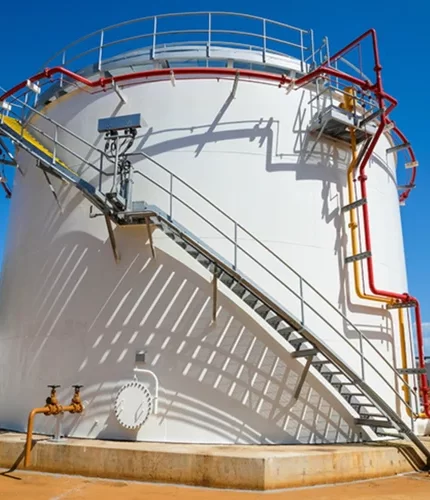
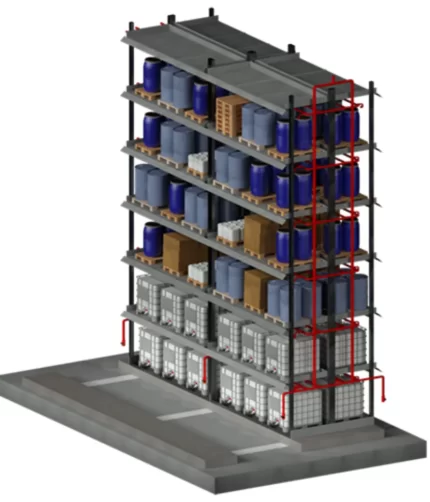
Chemical Storage Rack Fire Suppression System
Rated 0 out of 5
(0)
Highlights:
we offer water sprinkler systems and dry chemical systems as standard options which can be installed by our personnel or a specialist at the location. These systems have audible and visual alarms and can be fitted with a variety of fire suppression accessories. The ability to quickly control chemical fires increases safety and peace of mind when storing hazardous materials. Another point of emphasis when extinguishing fires is minimizing inventory loss. Our effective and compliant fire suppression systems and accessories help save lives and costly materials in the event of an emergency.
Types of Chemical Storage Fire Suppression
Dry Chemical Storage Fire Suppression.
Features and Benefits
- Protects against A, B, C type hazards
- Multiple suppression tank sizes available
- UL and ULC Listed
- FM Approved
Water Sprinkler
Clean Agent Fire Suppression Systems
Rated 0 out of 5
(0)
Highlights:
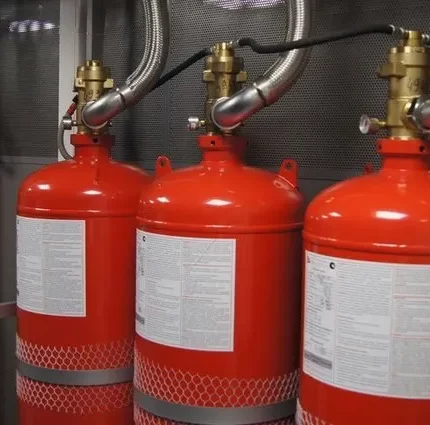
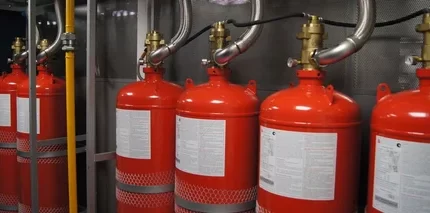
One of the most popular fire suppression systems is a clean agent fire suppression system. A clean agent is an electrically non-conductive, volatile, or gaseous fire extinguishing agent that leaves no residue upon evaporation. Clean agent fire suppression systems use inert gases or chemicals stored in containers, and discharged upon fire detection.
These agents are called ‘clean’ because not only do they leave no residue, but are also substantially more environment-friendly than all other options. Let us take a detailed look at these, shall we?
NFPA 2001 has defined the term “clean agent” as an electrically non conductive, volatile, or gaseous fire extinguishing agent that does not leave a residue upon evaporation. A clean agent fire suppression system will take either an inert gas or a chemical that is stored in a container and discharge it, when necessary, to extinguish a fire in its incipient stage.
Types of Clean Agent Fire Suppression Systems and Their Applications
When facilities contain irreplaceable artifacts, computer labs, or electrical rooms they utilize types of clean agent fire suppression systems for protection. These areas in a building have clean agent systems because they are waterless systems that extinguish fires with inert gases and chemical agents. These fire suppression agents require virtually no cleanup, non-conductive, and ideal for class A, B, and C fires. Since fire sprinkler systems use water to prevent fires from spreading, they would damage property in these areas.
What are the Types of Clean Agent Fire Suppression Systems?
There are three main types of clean agent fire suppression systems:
FM 200
Novec 1230
Inert Gas
FM 200 Clean Agent Fire Suppression System
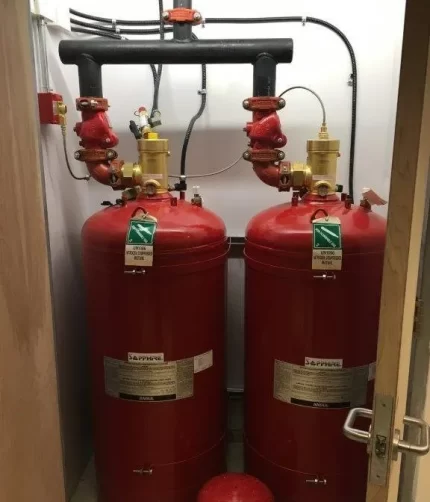
FM 200 clean agent fire suppression systems extinguish fires by quickly absorbing heat. The extinguishing agent is stored as a liquified compressed gas in cylinders near the area it protects. The agent flows through the system and changes into a gas that expels onto the fire when the system activates. The gaseous agent is relatively safe to use in human-occupied spaces and is often in computer rooms. Unfortunately, FM 200 systems have one of the highest ozone depleting ratings out of the three main types of clean agent fire suppression systems.
Novec 1230 Clean Agent Fire Suppression System
Novec 1230 clean agent fire suppression systems are like FM 200 systems in many ways. These systems suppress fire by removing heat and located close to the area it protects. Unlike FM 200 systems, the agent is stored as a liquid and is converted into a gas when discharged. This clean agent is a replacement for halon and an alternative to hydrofluorocarbon extinguishing agents so it’s not subject to the HFC phaseout. Novec 1230 is also the safest agent for human-occupied areas and its applications include data processing centers, race cars, and industrial facilities.
Inert Gas Clean Agent Fire Suppression System
Inert gas clean agent fire suppression systems use a combination of inert gases that exist as a gas and reduce oxygen in the area of the fire when expelled. In contrast to other systems, inert gas cylinders are highly pressurized and located further away from the area they protect. Some of their disadvantages include that they require more agent to suppress fires, therefore take up more space. Additionally, inert gas clean agent systems take longer to activate. The two types of inert gas clean agent systems include INERGEN and CO2.
INERGEN
INERGEN clean agent systems use a combination of nitrogen, argon, and carbon dioxide to suppress fires. Out of the three main types of clean agent fire suppression systems, INERGEN is the only system that has no global warming potential. These systems are safe to use in occupied spaces and are often in historical archives, museums, and art galleries.
CO2
CO2 fire suppression systems dispense carbon dioxide gas into a fire and in the process reduces oxygen and extinguishes the fire. Since CO2 poses health risks to humans at certain levels this type of system is usually an option for unoccupied spaces such as electrical rooms, spray booths, and flammable liquid storage areas. Unfortunately, these systems are sometimes in occupied areas. In these cases, facilities must take extra precautionary measures and have a safety plan in place for building occupants.
The three main types of clean agent fire suppression systems are used for many of the same applications. Unfortunately, there’s no perfect system and each one has its’ positives and negatives. Your best option is to speak with an expert. They’ll evaluate what you need to protect, occupancy frequencies, hazards, cost, and what’s important to you to craft a personalized solution that fits your needs.
CNC Panel fire suppression system
Rated 0 out of 5
(0)
Highlights:
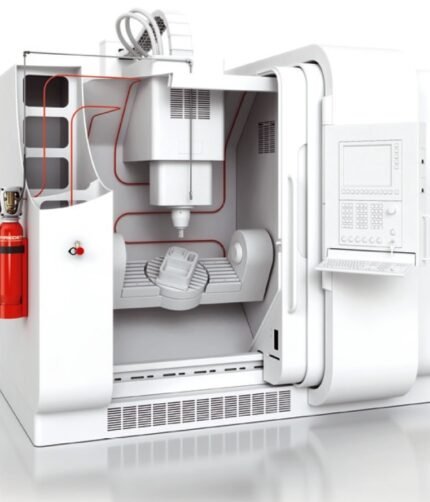
CNC Based Fire Protection are designed by Fire Engineering Technology to meet the most robust and demanding tandards in India and around the world. Our automatic fire suppression systems are independent of power supplies which ensures detection and suppression in any condition.
CNC Fire Suppression & Protection system are recognised by major insurance underwriters and supported by a comprehensive fire risk assessment before installation. Our CNC fire protection system is suitable to be fitted to all CNC machines including high precision machines and swiss.
The Reacton CNC machine fire suppression system uses our proprietary detection tubing, which once installed in the protected area will detect a fire inside the CNC Mills. Once the fire is detected, our automatic pneumatic value operates, causing the extinguishing agent to be released into the CNC Milling machines to extinguish the fire.
CNC detection system features :
Fully Vibration and Corrosion Tested
Integrated Isolation Valve
Stainless Steel alloy 303 (UNS S30300)
Multi Port High Flow Discharge
Multi Cylinder & Agent On One Detection Circuit
Please get in touch with us to discuss a CNC machining fire suppression risk assessment and solution.
Container Handling Rack Fire Suppression System
Rated 0 out of 5
(0)
Highlights:
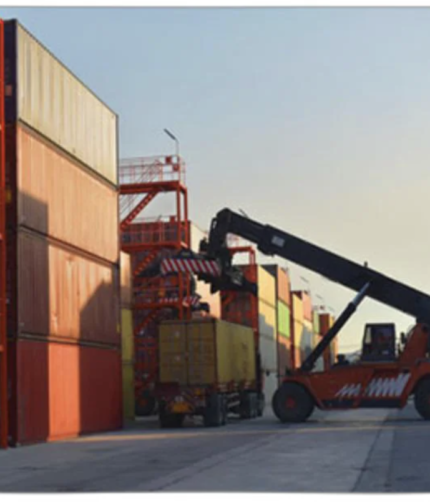
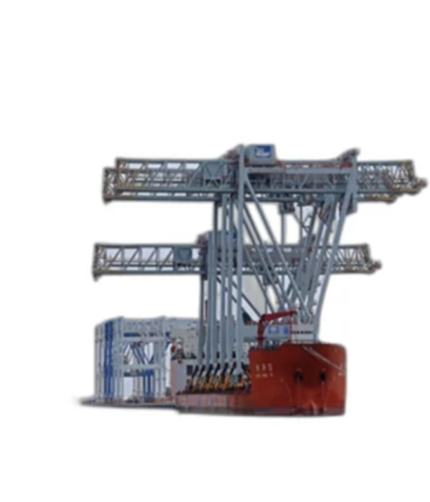
Installation of effective automatic fire detection and suppression systems on container handlers can help minimize equipment downtime, prevent loss of expensive equipment, and safeguard against serious injury.
Container Handling Rack Fire Suppression System
Areas to Protect in Container Handling Equipment
- Engine Compartments
Failures in hydraulic hoses or fuel lines can cause fuel or hydraulic oil to leak or spray throughout the compartment. Once in contact with hot components in the engine, the fuel or oil can ignite – filling the whole compartment with fire.
- Crane Electrical Panels
Overcurrent in panels within the crane’s electrical room can cause wiring and components to burn. A fire in an unprotected panel can destroy the panel and spread throughout the electrical room.
- Crane Electrical Rooms
Electrical faults can cause wiring and components to burn, and lead to arc flash within the crane’s electrical room. In these cases, the spread of fire can be catastrophic, destroying the room and possibly the crane, leading to collapsing booms and beams.
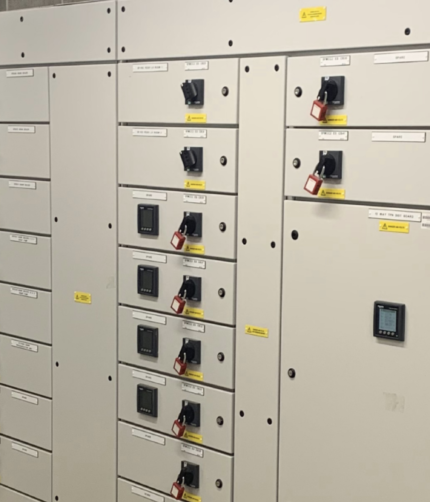
Electrical Panels Fire Suppression Systems
Rated 0 out of 5
(0)
Highlights:
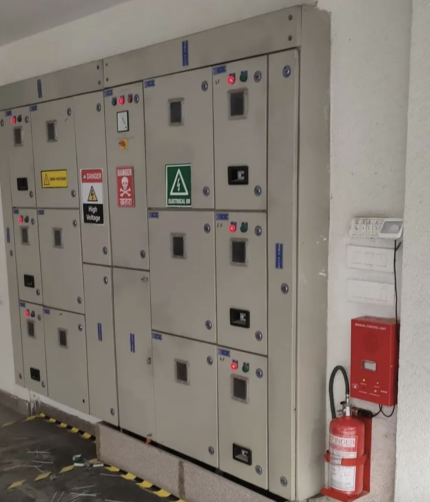
Studies show that a number of explosive fires can erupt from the general electrical panels present in practically every residential or commercial area. Regardless of the size of the electric panels, severe fire hazards can take place in them causing a lot of life and resource damage.
Since we believe in safeguarding you from fire hazards from all fronts, we also provide fire suppression system for electrical panels.
At Fire Engineering, your convenience and safety are our prime goals. To fulfil them, we design extremely proficient fire suppression systems for your electric panels which come ready for installation in your work unit.
Tube Based Gas Suppression System : One of the most prominent products/solutions at av safety solutions is the specially designed Tube-based Gas Suppression system, a revolutionary fire safety solution to keep safe what’s precious. The pneumatic mechanism triggers the valve of the extinguisher and sprays the extinguishing agent out of the tube directly onto the flame, dousing the fire instantaneously.
Unattended small short circuits are the main cause of most and major Fires. Fire in Server Racks or Electrical Panels are generally caused by a short circuits or small sparks but as they are not attended, they lead to serious hazards to life and property leading to personnel injuries, property damage further resulting in loss of productivity, money and precious time.
The following are the features of Tube Based System:
- Simple self-activating system without human intervention
- Linear Heat Detection – senses fire anywhere along the entire length of the fire detection Tube
- Extinguishes fire at an early stage
- System activates automatically
- Safe against malfunction
- More reliable, as system does not rely on complex electronics or moving parts
- System does not need external power supply for detection and extinguishing of fire
- Simple construction leads to easy maintenance
System Configuration:
- FET Fire Finder Tube for Detection
- Fire Extinguisher Cylinder with Automatic Valve Assembly
- Clean Agent Fire Fighting Gas
- Pressure Switch
- Audio Alarm
- Control Panel
DLP- Direct Low-Pressure Clean Agent Systems are primarily a Pre-Engineered Automatic Fire detection and suppression System utilising various Low-pressure Clean agents i.e. HFC227ea, Novec1230/FK-5-1-12.
The Linear Pneumatic Fire Detection Tubing (LP-FDT) is installed and connected to DLP Valve and routed throughout the protected hazard area/enclosure. The primary function of Pneumatic Fire Detection Tube (under pressure) is to detect heat/fire and activate the valve for discharge of the agent by rupturing at the hottest point along its installed length on flame impingement. On rupture a nozzle is formed at the burst point.
The clean agent under pressure, in the cylinder then flows out through the burst point, distributing the clean
Direct Low Pressure DLP Clean Agent System Unit.
Fume Hood Cabinet Suppression System
Rated 0 out of 5
(0)
Highlights:
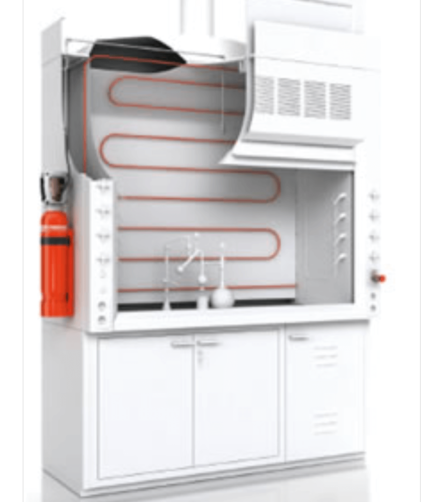
Fume hoods square measure thought of as a perfect means of protective chemical laboratories from fireplace explosions. However, a fume hood on its own may not be decent. several reactive chemicals during a laboratory may act within the fume hood to make severe hazards.
In order to secure chemical laboratories, prescribed drugs, etc. from such things, we’ve come back up with a specialised fume hood cupboard fireplace suppression system which might defend the lives and resources of our shoppers.
FUME HOOD CABINATE FIRE SUPPRESSION SYSTEM: Fire Engineering Technology a reliable & service based company has 500+ reputed satisfied customers for Fire suppression system.
A COMPLETE PRE-ENGINEERED SYSTEM
- Designed to protect Fume Cabinets and Chemical storage enclosures
- Everything you need together in one box
FULLY AUTOMATIC
- Automatically detects and suppresses fire
- No electricity required
FAST DETECTION
- Installs directly INSIDE fume cabinets – closer to where a fire can start
PROVEN TECHNOLOGY
- UL and FM-approved systems available
- Already protecting thousands of installations worldwide
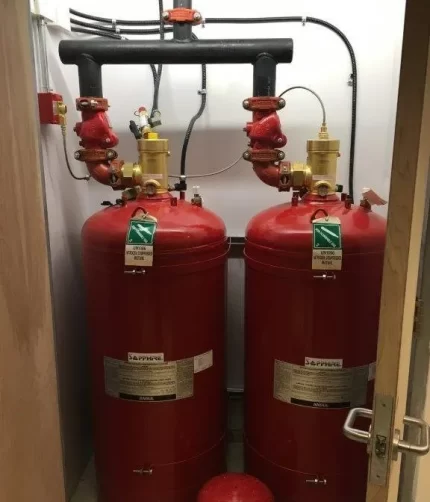
Kitchen Fire Suppression System
Rated 0 out of 5
(0)
Highlights:
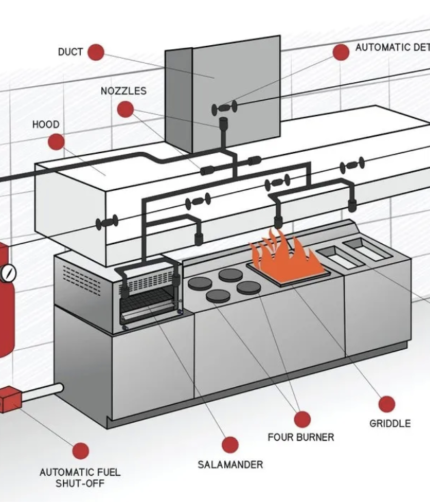
Restaurant kitchens area unit significantly pre-disposed to fireside hazards. Despite the constant destruction of flames, the massive range of practical gas stoves will cause a fireplace to erupt. Such a scenario in your edifice wouldn’t solely impact your business adversely however additionally hurt your staff, resources and time. At AV Safety Solutions, we’ve got in an elaborate way designed a room fireplace suppression system which will safeguard you against all such hazards.
Product potency
The system mechanically detects the presence of fireside while not the necessity for any human intervention.
Our system uses 3 strategies to discover the presence of fireside – liquified links, linear gas, and linear liquified links. Such a system ensures the fastest and most correct fireplace detection.
As presently as detected, the system straight off begins the method of fireside suppression to confirm minimum harm to life and resources.
We use a wet chemical for extinction the fireplace. Since this method is formed specifically for kitchens, the chemical used is one with an occasional pH scale and doesn’t corrode stainless-steel.
The system includes Associate in Nursing extinction tank that’s controlled and pre-filled to confirm immediate action and optimum safety.
The most distinctive quality of all {the fireplace|the hearth|the fireplace} Engineering fire suppression merchandise is that they’re created with utmost exactitude. we have a tendency to check them multiple times through multiple difficult tests. when we have a tendency to area unit certain that they perform well in dangerous things, we have a tendency to install them in your kitchens for your safety. that’s why once victimization our merchandise, you just don’t ought to worry concerning the standard.
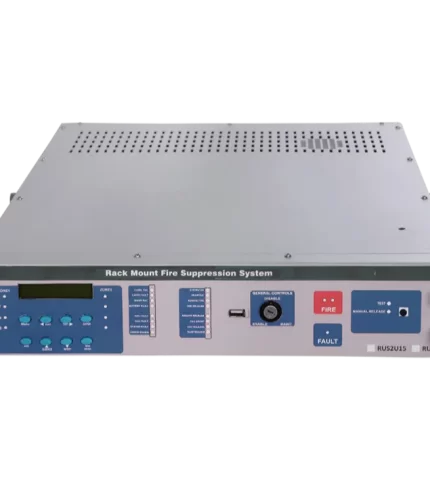

Record Handling Rack Fire Suppression System
Rated 0 out of 5
(0)
Highlights:
Records have an increased risk of fire- and smoke-related damage, more than many other materials. The nature of most archives and records often means that they consist of or have large amounts of very dry and old paper and books — items that are often highly flammable, as well as irreplaceable if a fire were to occur. Every archive or record repository, therefore, needs to take active steps to help prevent fires and to help reduce any potential damage to the building and its contents in the event of a fire.
Record Handling Rack Fire Suppression System
Types of Fire Protection Systems
Fire protection systems are categorized as active or passive depending on whether or not they perform an action to help extinguish the flames or alert people to the presence of the fire or whether their presence is enough to help block the spread of smoke and flame by itself.
Active Fire Protection Systems
Active fire protection systems help stop the spread of fire and smoke. By helping to contain the flames, they can help make it easier for active systems to extinguish them.
Passive Fire Protection Systems
Passive systems can help prevent damage to additional areas in the building and can make it safer and easier for occupants to exit.
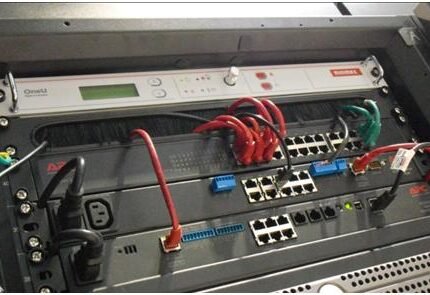
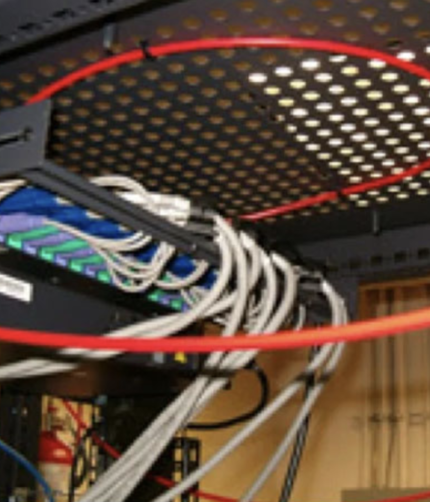
Server Rack Fire Suppression System
Rated 0 out of 5
(0)
Highlights:
Rack mount fire protection solutions are designed for installation into server racks and server cabinets to provide fast and effective fire detection and suppression and reduce the threat of fire to business continuity. When sizing a rack mounted fire suppression unit it is important to measure the physical space to be protected and ensure that the right size unit is selected and installed either as a single or multiple units.
Server Rack Fire Suppression System
Inert gas is a type of fire suppressant that safely extinguishes IT-related fires, while being safe for humans in the area and the environment. It is commonly used to protect smaller server rooms, particularly those where people are frequently. Data center fire suppression refers to various systems and solutions designed to stop a fire from spreading in a data center. You can typically find fire suppression systems aimed at different sections of a data center, such as those for the entire building, individual rooms and racks.
Vehicle Engine Fire Suppression System
Rated 0 out of 5
(0)
Highlights:
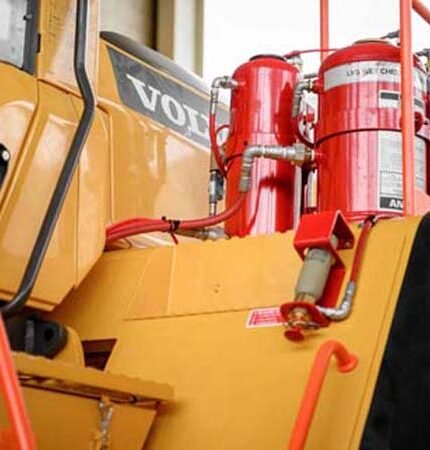
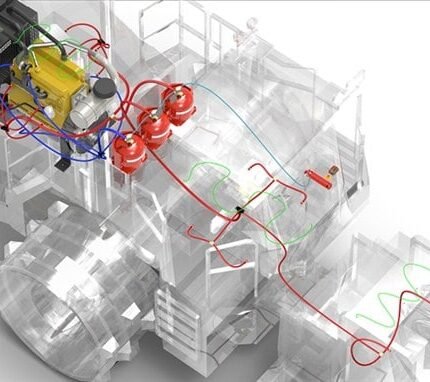
AV Safety Solutions offers a fully automatic, standalone fire protection system for vehicles, buses, and other engine and hydraulic system. We offer custom suppression systems to protect the vehicles, equipment, and vital assets.
Automatic vehicle suppression systems are designed with detection wires that are wrapped around the perimeter of the vehicle’s engine. When the insulation on one wire melts (reaching a temperature of 356? or higher), the melted wire touches the other wire and a message is sent to the control panel to dump the system and extinguish the fire
Manual systems on the other hand require the operator of the vehicle to push a button to initiate the suppression system.
Common causes of vehicle fires
There are several industries where vehicle fire suppression systems are used on heavy equipment. For example, landfills, underground mines, paper mills, railyards and power plants all have fire safety requirements for vehicles.
- Abrasion against a high-pressure hydraulic line causes a pinhole and leaks atomized hydraulic fluid onto a hot manifold.
- Combustible solids gather behind the hot exhaust manifold in the engine compartment of a trash truck.
- A short occurs in one of the machine’s electrical cables, setting the cable insulation on fire.
- Natural Gas or Hydrogen, highly flammable invisible fire hazards, ignite from the accidental discard of a cigarette butt.
- Coal dust ignites from a metal spark.
- A wiring harness near the battery shorts against the vehicle’s chassis, melts, and then ignites.
Wind Turbine Fire Suppression System
Rated 0 out of 5
(0)
Highlights:
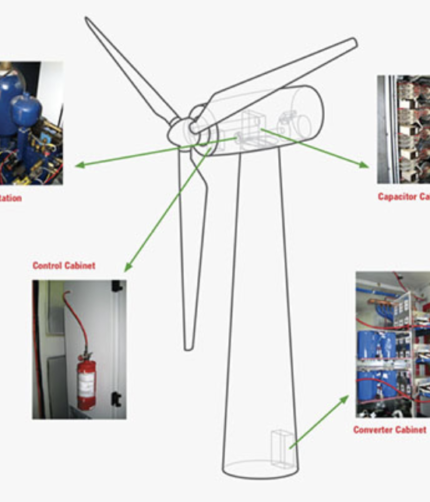
Wind turbines catch fire because highly flammable materials such as hydraulic oil and plastics are in close proximity to machinery and electrical wires. These can ignite a fire if they overheat or are faulty. Lots of oxygen, in the form of high winds, can quickly fan a fire inside a turbine.
Wind Turbine Fire Suppression System
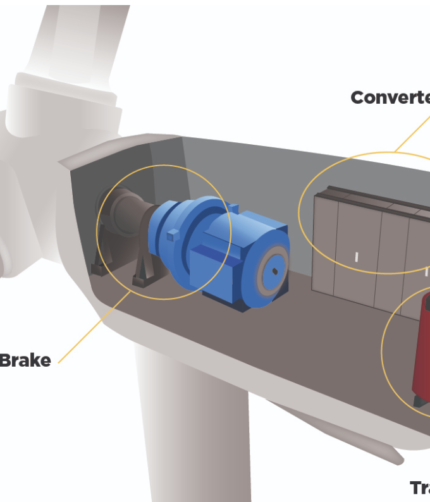
It is nearly impossible to put out a wind turbine fire using manual fire-fighting methods. The height of turbines, potential of the blade still rotating, and the remote locations many wind farms make them difficult, if not impossible, for local fire departments to battle. Combustible materials in the wind turbine are also risk factors. Composite materials are found in the blades, nacelle walls, and an estimated 235 gallons of lubricating oil and other highly combustible liquids that are held in the nacelle. These oils and liquids are used in the gearbox, yaw, hydraulic system, blade pitch change mechanism, oil pumps, mechanical brake, and oil-filled transformer. All that is needed is an ignition source to spark a fire.
Wind Turbine Fire Protection Options
Water-based
Carbon Dioxide (CO2)
Aerosol-based
Clean Agent